Your TDR file passed the portal. Would it pass a review?
Designed to check IFF, sales thresholds, and SIN classification before you submit in the Sales Reporting Portal, with TAA and clause questions flagged for contract-level review.
TDR Guard and FAR Guard have not launched yet. Requesting access does not activate either module.
Access is reviewed before activation.
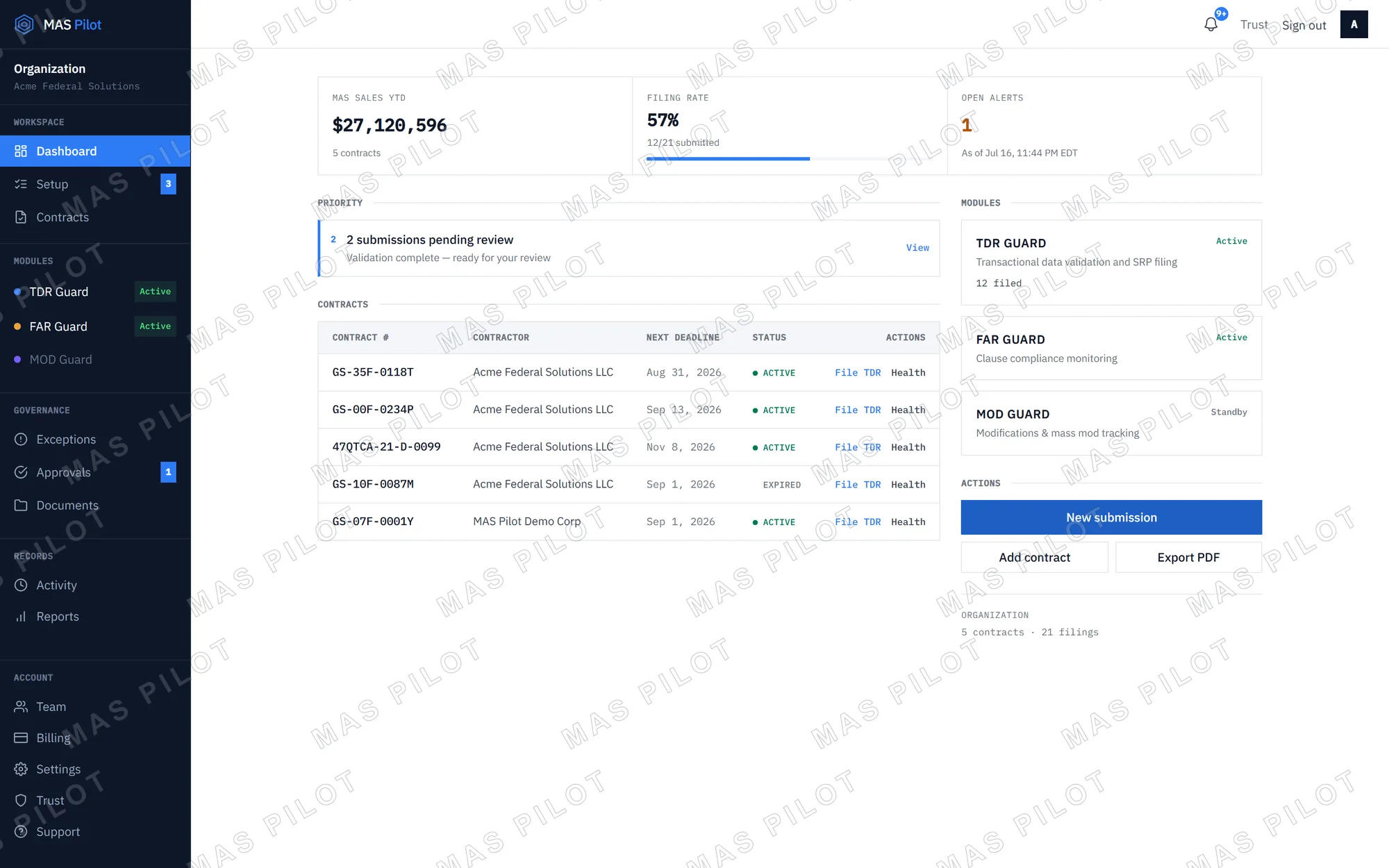
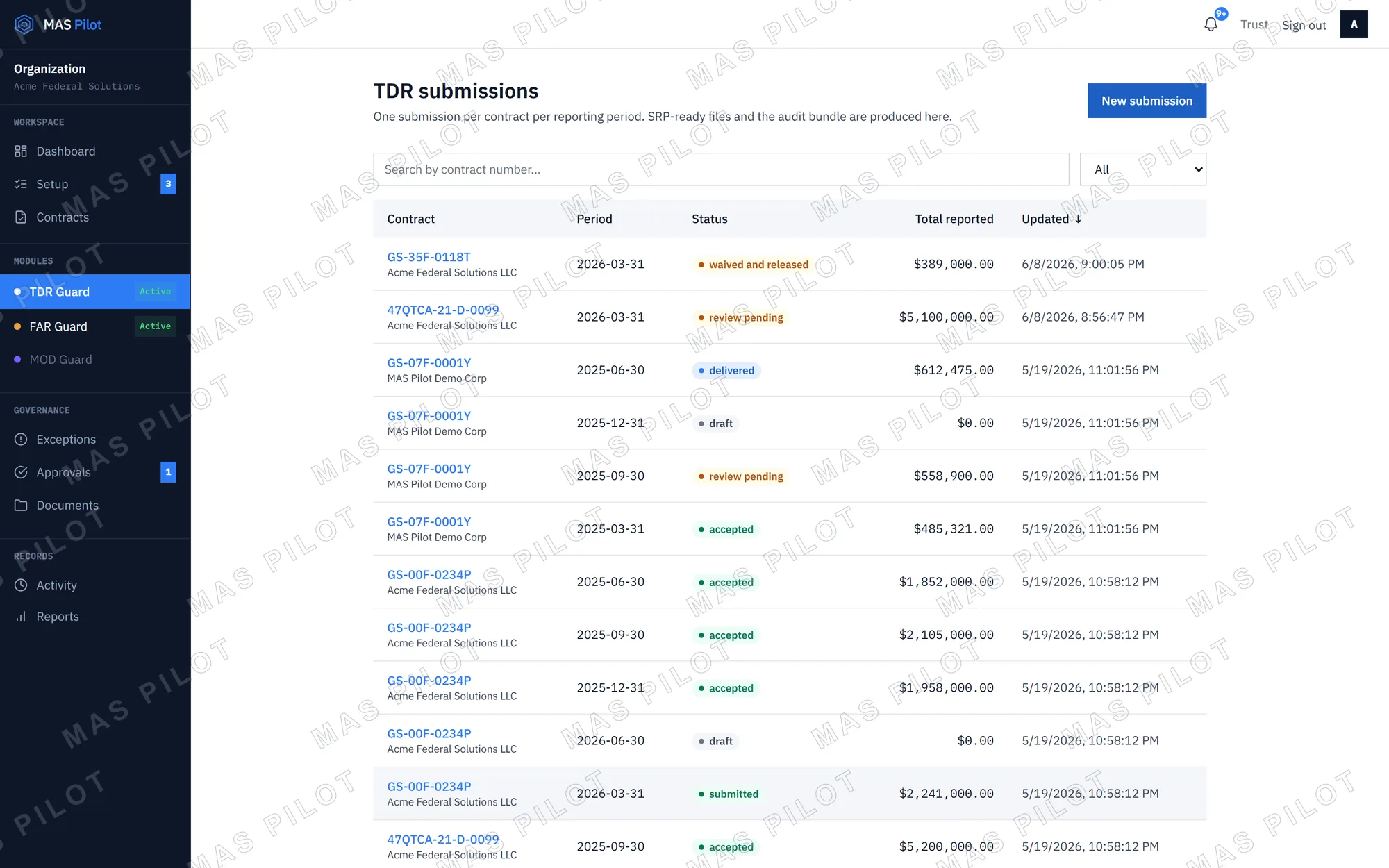
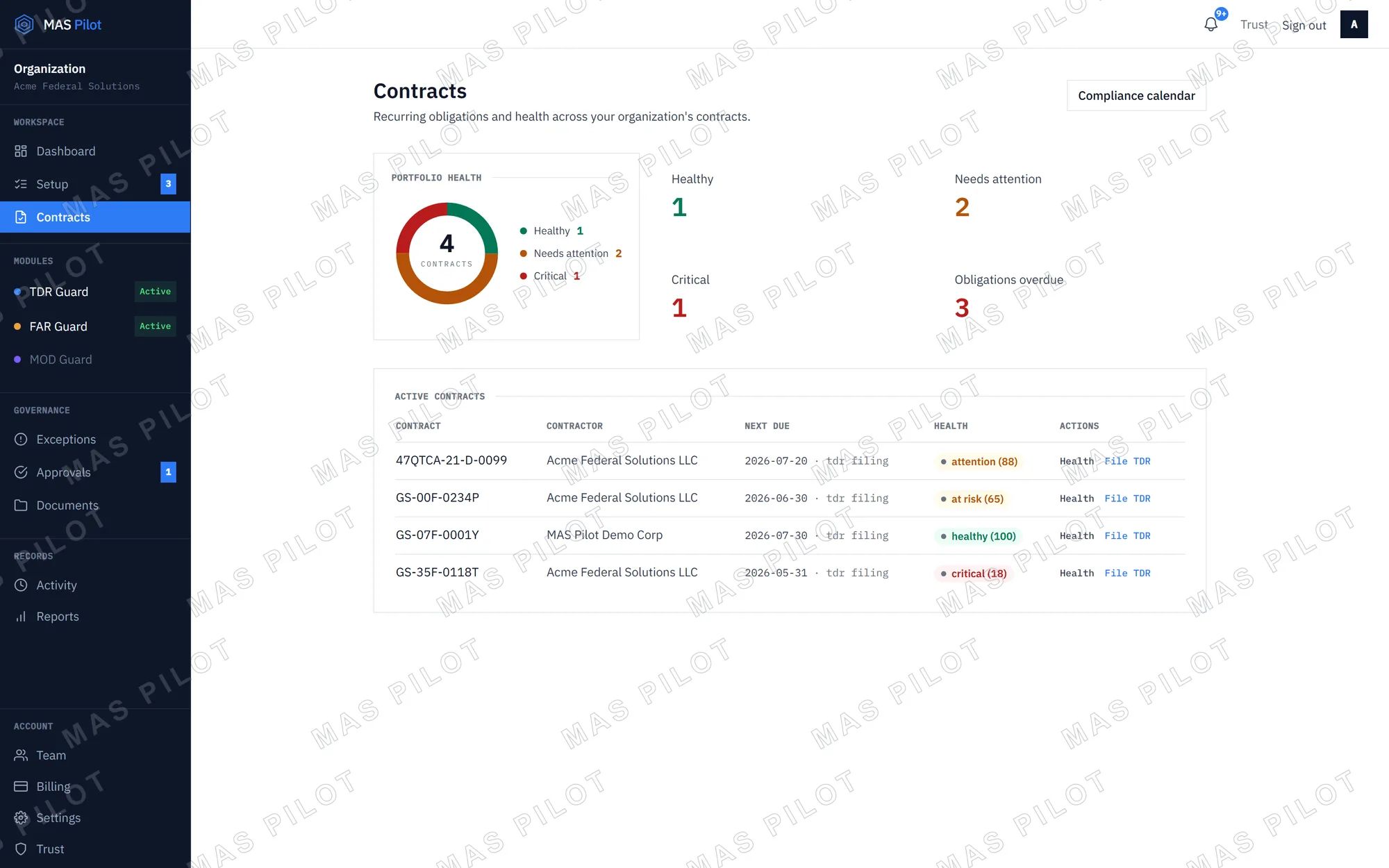
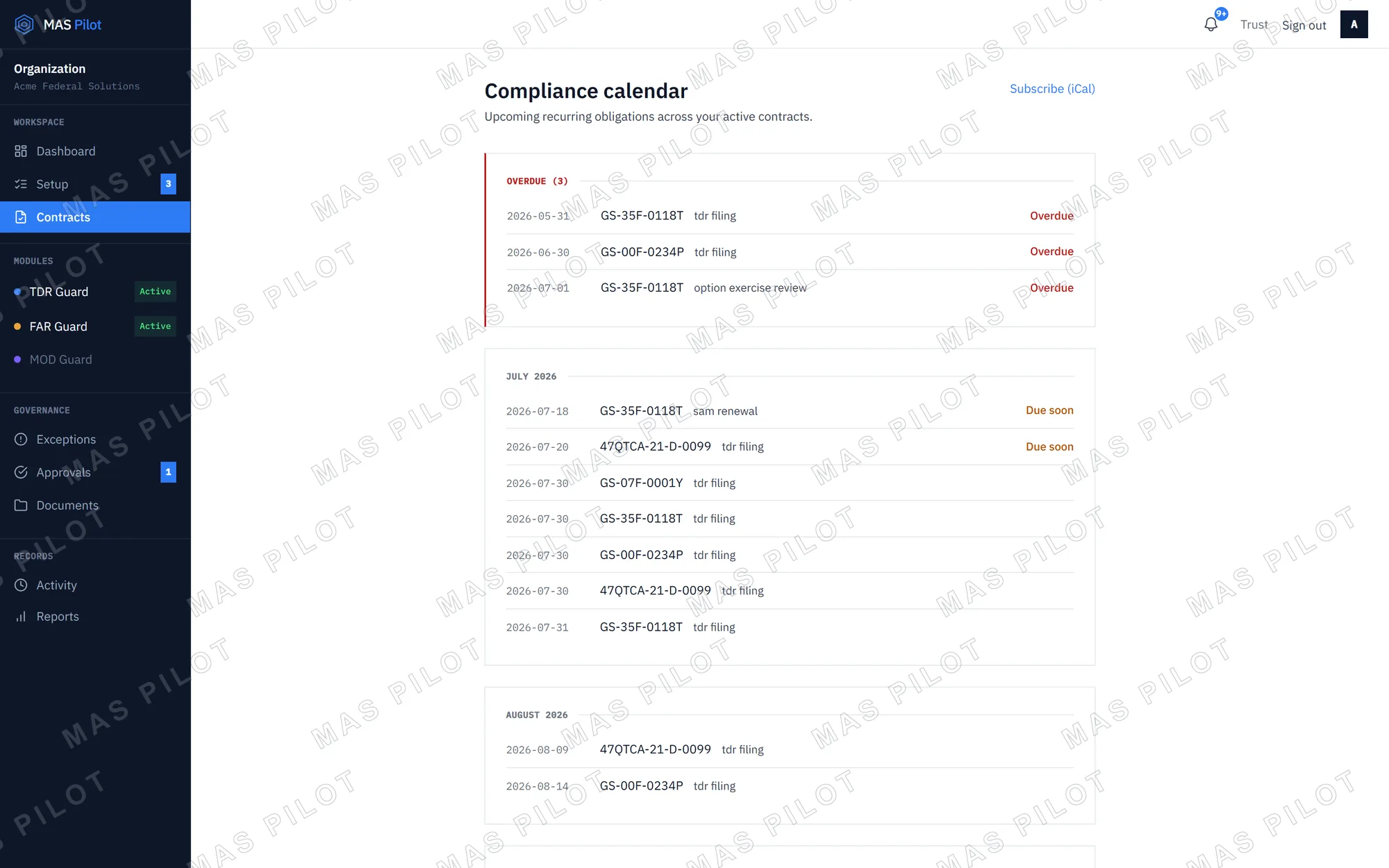
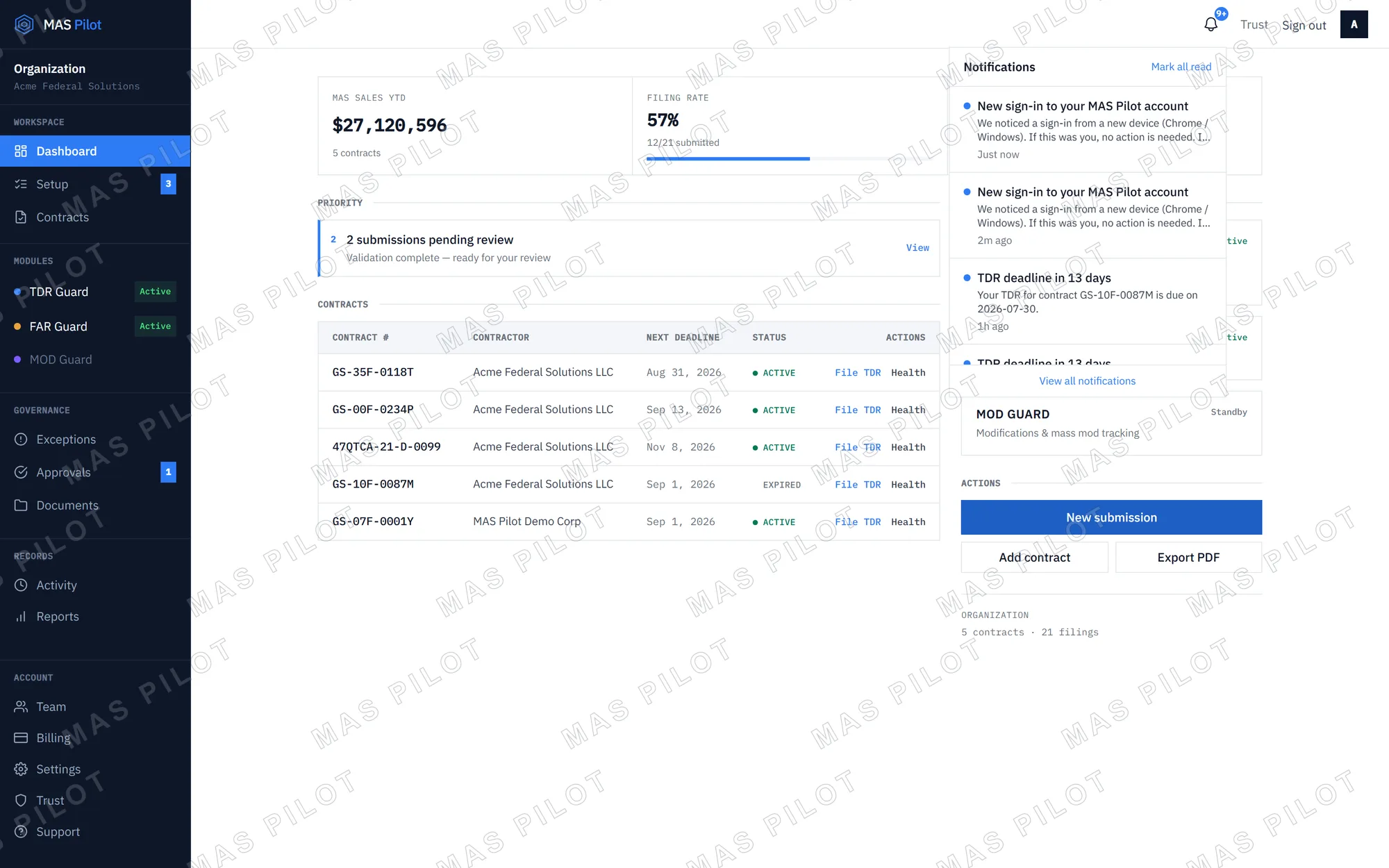
Illustrative MAS Pilot interface. Module availability shown may include modules in development.
A file the portal accepts isn't the same as a compliant one.
Due 30 calendar days after month-end, every month, including zero-sales months (GSAR 552.238-80).
GSA's Sales Reporting Portal validates format, rejects uploads that fail validation, and calculates the IFF due on the sales you report. But whether those sales are complete and correct, TAA and country-of-origin, the minimum-sales criteria, and clause applicability pass straight through it — and surface later, in a Contractor Assessment Visit, an option-year review, or a resubmission.
Is the free SRP enough? See the two layers → Source: GSA.gov — TDR Policy →IFF errors the portal accepts
The SRP calculates the fee on the sales you report. Missing or misreported sales carry a wrong fee straight through and surface in an IOA review.
Threshold & SIN risk
The $100K / $125K floors and wrong SIN mapping affect your contract standing.
TAA & country-of-origin exposure
Format-valid lines can still carry non-compliant country data a review will catch.
Clause & Mass Mod drift
FAR/GSAM clause gaps and late modifications quietly erode compliance.
Start with TDR Guard.
Designed for the monthly reporting cycle. Not launched yet.
See what TDR Guard is designed to check, and what it does not →
How it is designed to work
The plan: software flags it, an expert reviews it.
When TDR Guard launches, automated checks are designed to catch the issues and a credentialed federal-acquisition expert to review the high-risk ones before you submit. A borderline call becomes a person's judgment, not an algorithm's guess — and you stay the contractor of record on every submission.
A credentialed reviewer
The plan is for flagged items to be read by a GS-1102, FAC-C federal-acquisition professional with 17+ years' experience — not a black box you're asked to trust blindly.
Where the risk is
Expert eyes on IFF discrepancies, TAA exposure, and threshold and clause calls — the judgments software shouldn't make alone.
You still decide
Every finding is yours to accept or waive. You remain the contractor of record, and GSA makes every determination.
One platform. The full MAS lifecycle.
Launching first
Automated Transactional Data Reporting support for MAS schedule holders. Designed to check the required TDR reporting fields it supports, plus product, services and cloud line rules, calculate IFF at the rate in effect (currently 0.75%) for contractor review, generate SRP upload files (Excel on GSA's template, plus a pipe-delimited file) for contractor review before submission, and surface monthly deadlines. Contractor remains responsible for submission accuracy under GSAR 552.238-80 (DEC 2025 deviation).
- →Designed to check supported required reporting fields on every line
- →Designed to calculate IFF per period and track quarterly remittance
- →TAA review support when country-of-origin or catalog data is provided
- →Designed to generate SRP upload files for contractor review before submission
- →Designed to monitor the $100K / $125K minimum-sales thresholds and flag contract risk
- →Amendment and correction support
MAS Pilot's compliance engine, planned to be included with every account when access opens rather than sold separately. Clause state per contract, regulatory change signals from the public eCFR, SAM.gov registration watch, and a deadline radar for contract compliance dates.
- →Clause state per contract
- →Regulation drift via eCFR
- →SAM.gov registration watch
- →Deadline radar for contract compliance dates
Roadmap
Not available today. Named so you can see where the platform is going; nothing here is included in an account until it ships.
Contract modification drafting support, documentation packages, and cover-letter drafts for contractor review and signature. EPA calculations and justification narratives.
- →Drafting support across modification types
- →EPA calculation support
- →Submission documentation packages
Complete MAS schedule offer package assembly. SIN selection, pricing strategy, FCP catalog checks, and eOffer workflow guidance for firms pursuing a Schedule award.
- →Offer preparation assessment
- →FCP catalog checks
- →eOffer submission workflow guidance
Designed for sensitive contractor data.
These describe our security-by-design approach. Some customer-platform controls (e.g., role-based access, customer-account MFA, per-contractor audit trails, SOC 2) are targeted for general availability, not yet live — see the Security page for what is live today versus planned, and for our FedRAMP status.
Built for the system it serves.
The MAS program repeats the same failure every month: contractors run mandatory reporting from spreadsheets and find out about problems only after GSA does. The agency's own Inspector General put a number on the result — 73% of FY25 TDR-reported sales were unusable for price analysis.[1]
MAS Pilot is built to catch those problems first: a compliance engine that checks the work, while the contractor stays responsible for every submission and GSA makes every determination.
Refresh 31 made the deadline real.
TDR, Refresh 31, and MAS Pilot — quick answers
What is Transactional Data Reporting (TDR) for GSA MAS contractors?
TDR requires GSA Multiple Award Schedule contractors to report transactional sales data — a defined set of data elements, expanded under Refresh 31 — for orders under their MAS contract. Under Refresh 31, TDR is mandatory for every MAS SIN.
What changed in GSA MAS Refresh 31?
Refresh 31 (released April 2, 2026) made TDR mandatory for all MAS SINs, ended Price Reductions Clause tracking for TDR participants (a December 2025 deviation version of GSAR 552.238-81 applies under TDR), and removed CSP-1 disclosure requirements. The solicitation changes came via Mass Mod A914; non-TDR contractors transition via Mass Mod A909, which has a 60-day acceptance window.
What is Mass Mod A909 and what happens if I don't accept it?
Mass Mod A909 is the system-generated modification that transitions non-TDR contractors to mandatory TDR. GSA directs contractors to accept it no later than 60 days after issuance; not accepting within the window has contract-level consequences, which GSA states in the modification notice. Acceptance is two steps — A909, then a separate Participate in TDR modification. TDR takes effect on the first day of the sales-reporting quarter after acceptance: contractors who accepted by June 30, 2026 are effective July 1, 2026, with each month's report due within 30 calendar days after month-end; later acceptance moves the effective date to the following quarter. GSA's grace period (July 1 through December 31, 2026) applies to new contracts with a TDR effective date on or after October 1, 2025 and covers good-faith data-entry errors only; a separate trial period over the same dates covers the newly required data fields for all TDR participants. Sales must still be reported every month, including zero sales, and the IFF remitted in full on time.
What is the current IFF rate and how is it paid?
The Industrial Funding Fee is currently 0.75% of MAS sales. It is calculated on reported sales and remitted at least quarterly via Pay.gov (monthly is optional). Contractors remain responsible for the accuracy of IFF calculations and remittance.
What are the GSA MAS minimum sales thresholds?
$100,000 in total schedule sales across the first five-year period, and $125,000 in total during each subsequent five-year option period. GSA can cancel contracts that miss these thresholds (GSAR 552.238-79).
What does TDR Guard do?
TDR Guard has not launched yet. It is designed to check your monthly TDR before you submit: the reporting file, IFF calculations, SIN classification, the $100K/$125K thresholds, and applicable reporting preconditions. It is designed to raise TAA, country-of-origin, and clause questions for contract-level review through FAR Guard, not to determine TAA compliance from a TDR transaction line. It is also designed to calculate IFF for your review, generate SRP upload files (Excel on GSA's template, plus a pipe-delimited file), and track monthly deadlines. Its findings are decision-support only — GSA makes all acceptance and compliance determinations. MAS Pilot is designed to assist with preparation; submission accuracy remains the contractor's responsibility under GSAR 552.238-80.
TDR Guard and FAR Guard have not launched yet.
Requesting access does not activate either module. Access is reviewed before activation. Pricing is confirmed before activation.
MAS Pilot helps teams monitor and organize compliance-related information. It does not determine compliance, provide legal advice, or replace review by your contracts, compliance, or legal team.